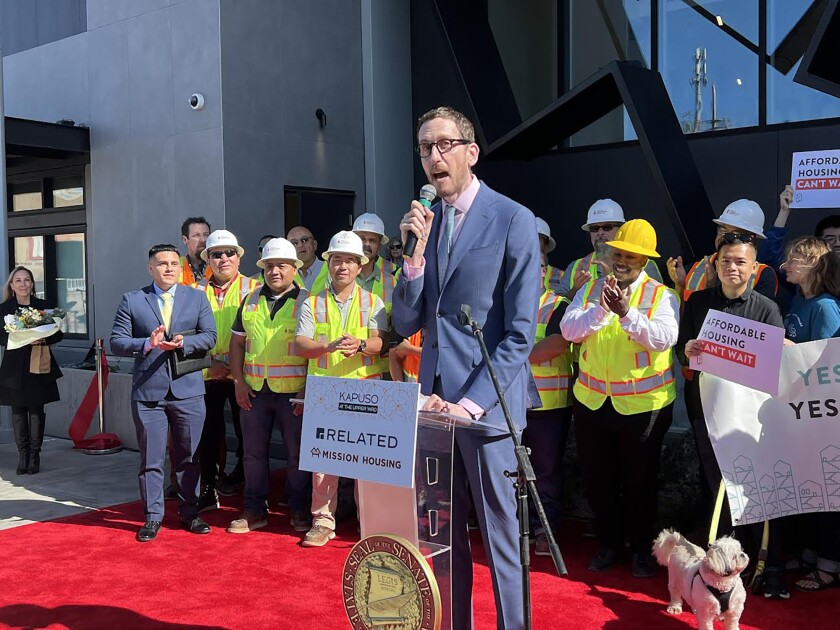
The latest measures — most notably Senate Bill 79, which provides by-right development rules for higher-density apartments and condominiums near transit stops — won’t go into effect until January, but several other major legislative reforms have been in effect for as long as eight years. And yet for all the bill-signing hoopla, the state has witnessed too few new developments. We’ve seen improvements around the edges, as San Francisco’s permit approval times have dropped, but overall the state’s housing market is as stubborn as ever. The Dallas-Fort Worth metroplex permits more housing than the entire state of California.
The California numbers certainly paint a dismal picture. Over the last decade, median statewide home prices have nearly doubled, from $476,000 to $877,000, as housing production has fallen short of projected needs by an average of 100,000 units each year. As the Sacramento Bee reported, in 2024 Sacramento issued just 2,387 of the nearly 5,700 housing permits needed to stay on track toward its 2029 goal of 45,580 new homes. It’s a familiar pattern in localities across the state.
YIMBY Law, a “Yes In My Backyard” advocacy group, provides a dispiriting picture in a report reviewing the results of five major housing laws enacted since 2021. These laws allow lot splits and duplexes in single-family neighborhoods (SB 9); by-right development approvals (the right to build without a discretionary approval by the local government) for multifamily housing along commercial corridors (Assembly Bill 2011); discretionary housing developments on commercially zoned land (SB 6); by-right affordable housing developments on land owned by religious and educational institutions (SB 4); and by-right approvals for small subdivisions on land zoned for multifamily housing (SB 684).
That all may sound like significant progress, but the laws have had “limited to no impact on the state’s housing supply to date,” the YIMBY Law report concluded. “While the hope was that these laws would provide immediate new paths to regulatory relief, they also allow or mandate development requirements that have reduced their effectiveness.”
There are some encouraging exceptions. In the Los Angeles area, accelerated permitting for rebuilding after last January’s devastating wildfires illustrates the potential for more wide-ranging reforms. And a report by two University of California professors found that the state law promoting the construction of accessory dwelling units (ADUs) has sparked noticeable construction of ADUs. But that’s a drop in the state’s housing bucket, and most Californians — 71 percent of them, according to a 2023 Public Policy Institute of California survey — want to live in a single-family, detached home rather than in a tiny backyard apartment or a “granny flat.”
Most of the YIMBY housing reform laws certainly are praiseworthy, as they deregulate approvals and provide exemptions or streamlining to the onerous California Environmental Quality Act (CEQA). Yet that 1970 law, which requires environmental impact reports for projects subject to a governing body’s discretionary approval, remains an open invitation for lawsuits, since any “stakeholder” can file one to stop or delay a project for any reason. Unions are notorious for using CEQA to secure wage concessions from developers. Yet lawmakers have taken only a piecemeal approach to CEQA, providing an exemption here and there without revisiting the entire law.

Housing advocates also pinpoint slow progress against obstructionism by local governments and new requirements that the laws impose on exempted developments. The latter is the result of typical Capitol horse trading. Sen. Scott Wiener, the San Francisco Democrat who has led the charge for YIMBY laws, ran up against the usual suspects who extracted concessions that muted the benefit of the reforms and ultimately took their toll on the laws’ effectiveness. As YIMBY Law put it, “Cities have actively undermined the goals of state housing laws through restrictive ordinances and creative interpretations.”
The offenders run the political gamut, from slow-growth liberal communities in Marin County north of San Francisco to the conservative Orange County city of Huntington Beach, which used “Not In My Backyard” (NIMBY) arguments in its lawsuit challenging state streamlining laws. The state successfully pushed back, but there still isn’t a significant amount of new housing to show for the effort.
To his credit, Newsom held up the state budget to force the legislature to pass two housing bills that provide CEQA exemptions for high-priority projects — an unusual maneuver that heartened housing advocates. And the governor willingly took heat for signing SB 79 after NIMBY groups made absurd claims that such legislation would destroy suburban communities.
The political landscape probably won’t improve given Wiener’s likely departure to Congress and the Senate’s elevation of environmental champion Monique Limón, a Santa Barbara Democrat, to the chamber’s top leadership spot. So expect lawmakers to continue avoiding the most obvious reason that these laws, however useful and well-intentioned, aren’t achieving their desired results: They focus on jump-starting multifamily, high-density housing. Such projects fill a niche and make sense in the state’s biggest cities, but until the legislature deregulates all types of construction — including single-family developments — it’s not going to make a huge dent in the housing shortfall.
One promising proposal would simply sidestep the legislature. The influential California Chamber of Commerce is currently advancing a statewide initiative that would reform CEQA in a more wide-ranging manner. “Rather than provide piecemeal exemptions,” according to the chamber’s statement, the ballot measure “would establish reasonable timelines for local and state agencies to review plans and solicit public comment. Timelines would also be established for any necessary judicial review.” The measure applies to essential projects, but defines “essential” as including many types of residential development.
Expect plenty of NIMBY pushback. As the Southern California News Group’s editorial board noted in supporting the chamber effort, “We’re already hearing from CEQA supporters who claim that Californians should wait to see how Newsom’s latest reform is working before trying anything else.”
We’ve waited long enough. Californians already have seen that years of reforms haven’t produced much new housing. It’s time to pass a “groundbreaking” reform that leads to actual groundbreakings.
Steven Greenhut is Western region director for the R Street Institute. He can be reached at sgreenhut@rstreet.org.
Governing's opinion columns reflect the views of their authors and not necessarily those of Governing's editors or management.
Related Articles