In Brief:
- Healey has emphasized practical economic issues like addressing high cost of living, repairing the beleaguered public transportation system, boosting affordable housing and cutting taxes. Many of her gubernatorial challengers are also highlighting affordability.
- Healey’s first term also saw her declare a state of emergency over soaring demand of the state’s emergency shelter system.
- The governor has presented herself as a pragmatic political leader — a trait that could go far in a state where getting along with the powerful legislature is essential for gubernatorial success.
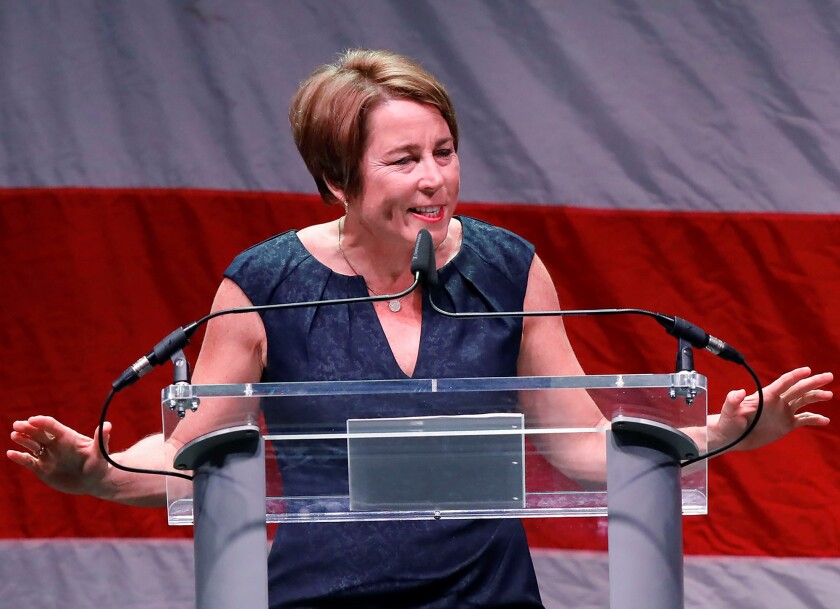
Maura Healey became the first openly lesbian governor in the U.S. in 2023 and shattered several glass ceilings in Massachusetts as well. She’s the Bay State’s first elected female governor, and she comes to the role after serving as state attorney general, making her the first person in 50 years to successfully make that transition.
Healey is a Democratic governor of a deep-blue state, but she eschewed sweeping progressive changes in favor of building a reputation as a pragmatic politician focused on bread-and-butter issues. The governor spent much of her first term attending to challenges around housing, public transportation and cost of living, and she hopes that reputation will carry her into a second term.
“When [Lt. Gov. Kim Driscoll] and I started, we laid out in our inaugural address things that we wanted to do. We wanted to get after housing, and we wanted to get after transportation, we wanted to cut taxes, we wanted to make investments in education,” Healey said in the announcement of her re-election campaign. “We’ve done all those things, and there’s a heck of a lot more to do.”
A national October poll found Healey ranking as the 10th most popular U.S. governor, with a 59 percent approval rating.
The governor has had to confront “inherited challenges that had stymied her predecessors,” says Democratic Sen. President Karen Spilka, including the state’s struggling public transit network, unaffordable housing market and overburdened emergency shelter system. That shelter system has struggled over the past two years to support a flood of migrants in need, and this issue appears top-of-mind for voters: A Massachusetts poll found that residents say housing is their top concern, with immigration and homelessness tying for the second-most-important item.
Healey has made “real, lasting progress” in addressing these issues, Spilka says. But she has her detractors, including from Republican gubernatorial challengers, as well as some progressives who have called her approach to the state’s emergency shelter crisis “Trumpian.”
Transit: Back on Track or Spending Run Amok?
The state subway and commuter rail system faces decades of delayed maintenance. Several 2022 incidents threw the issue into sharp relief, including a train car catching on fire and two other trains crashing. Healey installed a new head of the agency, and there’s been a real improvement to safety and reliability, says Caitlin Allen-Connelly, executive director of TransitMatters, a Massachusetts group that advocates for accessible and reliable public transit.
For decades, the subway has had “slow zone” or “speed

“Healey-Driscoll Administration, MBTA celebrate launch of South Coast Rail” by Joshua Qualls/Governor’s Press Office
“We’ve made great improvements on the safety front with the track improvement program,” Allen-Connelly said in August. “Last year, there was probably about 45 minutes of slow time across the subway system; today, the entire system has about only two minutes of slow time.”
General Manager Eng kicked off his leadership of the MBTA in 2023 with a hiring spree to address staffing shortages that some had blamed for service and safety issues, growing the agency’s workforce by 10 percent that first year. But some criticized heavy increases in overtime pay at the agency, which rose 48 percent from 2021 to 2024.
The Healey administration also promised big investments to close a budget gap at the transit agency, preventing service cuts and layoffs and enabling station upgrades and more frequent train service. Early into 2025, she announced plans to invest $8 billion over 10 years into public transportation, roads and bridges, a goal that made it into the FY 2026 budget.
But critics charge that new transit leadership is throwing money and new staff at the problem, without increasing cost efficiency.
“[The agency] is a huge money pit now,” says Paul D. Craney, executive director of the Massachusetts Fiscal Alliance, a nonpartisan but conservative-leaning nonprofit focused on economic opportunity and government fiscal responsibility. “It’s still a very unreliable source of transportation” and not yet back to pre-pandemic ridership levels.
Funding remains a concern. Healey’s planned major transit investment is a one-time infusion. Allen-Connelly says the state needs to better develop a long-term, stable funding plan.
An August poll of 1,000 Massachusetts residents found 28 percent of respondents rated subway and trolley service as “excellent” or “good,” while 27 percent said it was “poor.” (Respondents had higher ratings for bus, ferry and commuter rail services.)
Healey may also have a tricky time pleasing all sides on cost of living. She inherited “the millionaire’s tax,” a surtax on incomes over $1 million. This tax delivers revenue for public education and public transportation — including that big infusion to the subway system — but it has also come under fire from others who argue the tax stifles business. Healey has touted the tax cuts she made early in her first term, but received some criticism from conservatives over more recent tax proposals on items like pharmaceuticals and candy.
Still, none of those issues has been as controversial and politically contentious for Healey as housing and homelessness.
Housing and the Emergency Shelter Crisis
Massachusetts has a high homelessness rate and housing costs rise fast. When Healey stepped into office, the housing shortage was waiting for her.
To address it, Healey created an Office of Housing and Livable Communities and secured a major housing-focused bond authorization to fund affordable housing. Her administration also released the first-ever statewide housing plan, which aims to increase the housing supply, reduce evictions and support first-time homebuyers, among other goals. “It’s a really good plan,” says Joyce Tavon, chief executive officer of the Massachusetts Housing & Shelter Alliance, a nonprofit focused on reducing adult homelessness.
But change is slow, and homelessness has been rising. It grew nearly 28 percent from 2022 to 2024. And early in Healey’s term, the problem exploded.
Massachusetts is the only state with a law guaranteeing emergency housing to homeless families and pregnant people. In 2023, demand surged, heightened by an influx of struggling newcomers to the state, many from other countries. The number of families in need tripled from January 2023 to August 2024.

State House News Service/TNS
In response, Healey declared a state of emergency and capped the number of families the state would serve, as well as how long they could stay in a shelter. She instituted criminal background checks for applicants and proposed changing the right-to-shelter law to reduce eligibility, including adding residency requirements. The emergency declaration remained in place for two years, lifting in August 2025.
The crisis was a sensitive one. Some charged the state spent far too much, especially on people who had just arrived in the state, while others said the cap led to many migrants sleeping on airport floors when unable to get shelter.
Healey, meanwhile, has sought to frame her approach as simply pragmatic, says Jerold Duquette, professor of political science at Central Connecticut State University.
“She supported changes that certainly didn’t seem terribly progressive … . She dealt with that crisis in a very pragmatic way,” Duquette says. “I think it was about framing the situation in terms of resources — which is something that may draw the ire of progressives, but certainly does not draw the ire of the average voter, even the average registered Democratic voter.”
Will She Win a New Term?
Healey’s re-election bid will see her face off against Republican challengers trying to hit her on some of the same affordability concerns she’s touting, as well as on the emergency shelter crisis. Those include former MBTA head Brian Shortsleeve and former state Housing and Economic Development Secretary Michael Kennealy. Former medical device company CEO Mike Minogue, who joined the race as a third Republican candidate in October, has also highlighted cost-of-living concerns and said he plans to outright refuse shelter to undocumented migrants.
Shortsleeve has blamed Healey for the MBTA’s woes, saying in a campaign video that, when former Gov. Charlie Baker called him in to fix a “falling apart” public transit agency, he cut waste and balanced the budget. “We turned things around, until Gov. Healey took it back and broke the budget all over again,” he said.

Nancy Lane/Boston Herald
In her first run for governor, Healey was bulletproof, Duquette says: “She could’ve shot somebody in the middle of Fifth Avenue and still won.” Back then, she was the state attorney general and her aggressive prosecution of some cases forestalled any potential accusations of being soft on crime. At the same time, progressives who are normally turned off by law enforcement experience saw in Healey the promise of social progress. “She had all of the, sort of, identity cues that indicate a progressive type of politician.”
Fighting President Donald Trump helped keep Healey in headlines, too, as she frequently sued the federal administration over issues like its ban on travel from Muslim-majority countries, separation of immigrant families, and matters related to birth control, gun regulation, health insurance and more. Ultimately she became the first attorney general in 50 years to win the governorship in Massachusetts. She was ushered in with nearly 64 percent of the vote (just below the 65 percent her predecessor, Republican Charlie Baker, had won in 2018).
The other key to success, Duquette believes, lies in her reputation as a careful, pragmatic politician who isn’t going to deeply overhaul things. Governors are fairly weak in Massachusetts, sharing power equally, or even as a junior partner, to the Senate president and speaker of the House, he says. Governors need to show they can be good partners with a legislature that tends to favor stability, and her campaign was similar to that of her moderate Republican predecessor.
“Part of why she ran her campaign as Charlie Baker 2.0 is because she wanted to make sure that the legislature understood that she wasn’t going to come in there and try to overturn the status quo,” Duquette says. “Any governor who tries to do that kind of dooms their ability to be effective in Massachusetts.”
Healey appears to have built a strong working relationship with legislative leaders. Senate President Spilka notes she’s worked well with Healey to “deliver meaningful progress” on housing, economic development and health care.
“Gov. Healey brings a collaborative, results-oriented approach to the corner office, focusing on real issues that affect people every day,” Spilka says.
Looking ahead to the next gubernatorial election, Duquette believes that the state’s strong distaste for Trump makes it difficult for a Republican candidate to win. And, he notes, Massachusetts has for decades always given an incumbent governor a second term, if they survive their primary. What Healey now needs to do is keep proving herself to be a competent official who the legislature can work with, and “she’s going to get re-elected.”