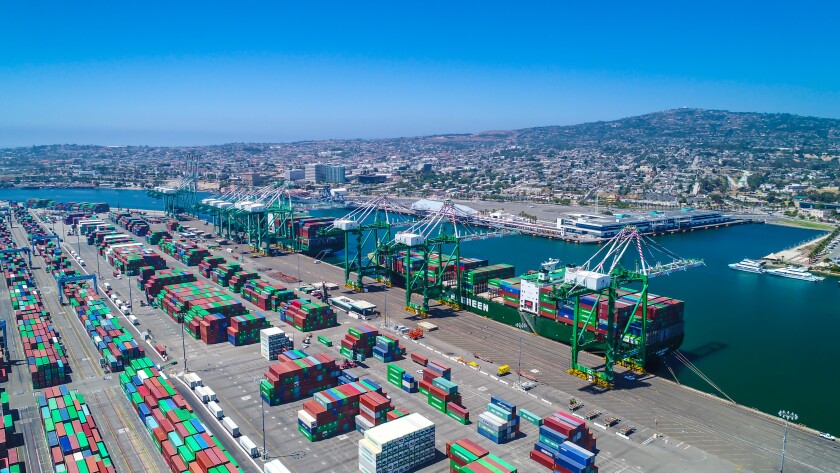
In Brief:
- The Port of Long Beach is the second-busiest container seaport in the country.
- It handles hundreds of billions of dollars in goods each year and supports millions of jobs.
- The CEO of the Port of Long Beach talked to Governing about his job at the “intersection of trade, geopolitics, climate and technology” at a time of tariffs and conflict.
Ports are so important, “port” is part of the word itself, Noel Hacegaba likes to say. Hacegaba is the CEO of the Port of Long Beach, the second biggest in the country.
This isn’t common knowledge in his city, however. “I've been at the port going on 16 years, and I still run into people that are trying to figure out what a port is and what a port does,” Hacegaba says.
Port productivity is measured in its throughput of TEUs (“twenty-foot equivalent units”), a term derived from the length of a shipping container. Last year, Hacegaba oversaw enough unloading, loading and shipping to reach 9.9 million TEUs. It was a record, close to the 10.2 million at the Port of Los Angeles.
In 2005, the port announced an intention to become a “green” port through a focus on environmental stewardship and sustainability. It was the first port in the country to do so, Hacegaba says.
A 20-year progress report issued last year said that even though container traffic had increased 20 percent, hazardous emissions from port activity had gone down dramatically. (Diesel particulate matter by 92 percent, sulfur oxide by 98 percent and nitrogen oxides by 71 percent.)
Hacegaba’s 2050 vision for the port sets the goal of becoming the world’s first zero-emission port, while increasing its throughput to 20 million TEUs.
In a conversation with Governing, he talks about his role as a port CEO, his ambitions for the port of Long Beach, and the impact of federal actions on the port. The interview has been edited for length and clarity.

(Bernadette McKeever)
For most of our history, ports have been invisible. Folks go to the store and they buy a product that says “made in Vietnam,” not really thinking about how that product got here.
The pandemic supply chain crisis helped to change that. Ports went from invisible to infamous because all of a sudden, everyone was blaming ports for the backlog. In that process, policymakers and consumers alike discovered the significance of ports.
The Port of Long Beach alone handles $300 billion worth of goods annually. We support almost 3 million jobs across the nation, 1.7 million across the Southern California region. We are a massive economic engine; when ports are not functioning properly, the economy feels it immediately.
Have you seen a change in traffic following the introduction of new tariffs?
On Liberation Day, when new tariffs were announced, there was a lot of doom and gloom. Some were suggesting that our container volumes would be 20 to 30 percent lower than the prior year.
Instead, the starts and the stops of the tariffs led all the shippers to advance shipments. We call that “front loading.” Instead of being down 20 to 30 percent, we ended up in record territory. Last year, the Port of Long Beach alone handled 9.9 million TEUs.
Do you expect that to happen again this year? Are you seeing any impact from military activity in Iran?
We may not have another record year like we did last year, but I still think it's going to be strong unless something changes dramatically. Consumers in America are going to continue to buy things, and as the Fed continues to reduce interest rates there's more disposable income in our pockets.
Despite growing uncertainty fueled by the conflict in the Middle East, cargo volumes at the Port of Long Beach remain positive. Cargo continues to move fluidly. Planned shipments are on schedule, and the Port of Long Beach remains a safe harbor in the sea of trade and geopolitical uncertainty.

(Port of Long Beach)
How are ports different from other infrastructure?
Ports sit at the intersection of trade, geopolitics, climate and technology. All these forces converge at the ports.
The way that we have been successful in advancing our initiatives, whether infrastructure, development, sustainability or digitalization, is by employing what I call next-level collaboration. The port authority is like the conductor in an orchestra. Our job is to make sure every segment of the supply chain, every stakeholder, is playing off the same sheet of music.
This is why having a bold and clear vision is so important. Our 2050 vision to double our container throughput and build the port of the future is not just signaling to the market that we're bullish on the future. We're putting our money where our mouth is and investing $3.2 billion over the next 10 years. That's the largest capital expenditure program of any port in North America.
The centerpiece of our investment program is our Pier B On-Dock Rail Support Facility, the largest in-port railyard of any port in the world. We're going to be tripling our capacity to handle more containers from a ship straight onto a train.
That’s going to help us reduce the time it takes to get a container from a ship to a train from four days to one day. Two-thirds of all the cargo containers that arrive in our port end up east of the Mississippi. Our ability to connect with the nation's key rail hubs, whether it's Columbus, Chicago, Memphis, Kansas City or Dallas — that’s incredibly important for competitiveness and our ability to offer value to our customers.
You are part of a local government, the city of Long Beach. Can you think of another part of local government that has similarly wide-ranging impact?
The only other example that comes to mind is airports. But 90 percent of the world’s trade travels on ships. Ports like ours connect the world to our city, region, our nation. We support the state economy, the fourth largest economy in the world, but we are also vital to the nation's transportation system and the global supply chain.

(Port of Long Beach)
As we're seeing unfold, disruption anywhere in the supply chain, whether it's the Middle East or Asia, has a way of cascading across the global supply chain.