
News
Maryland's governor-elect, Larry Hogan, announcing that he plans to declare a state of emergency regarding heroin once he's sworn in.
Building on previous suggestions, including the establishment of two specialized Ebola treatment centers, a task force on Thursday released its full report on how the state could better handle an outbreak of an infectious disease.
The governor faces a skeptical Legislature, though, especially after he and lawmakers learned this week that any alternative to expanding traditional Medicaid will cost millions more than previously thought.
A new Georgia Supreme Court decision is leading to the cancellation of tens of thousands of arrest warrants for people accused of failing to complete their misdemeanor probation requirements, a newspaper reported Thursday.
Often criticized for perpetuating a city of haves and have-nots, Mayor Rahm Emanuel fired back Saturday with his own tale of two cities -- the old Chicago and new Chicago -- as he kicked off his campaign for a second term.
Pennsylvania Attorney General Kathleen G. Kane will not defend a new law that effectively stripped municipalities of the right to enact their own gun measures, raising the prospect that the controversial statute might not take hold.
A more-than-yearlong effort by New Jersey lawmakers to determine who was ultimately responsible for the September 2013 lane closures at the George Washington Bridge -- and why they happened -- has not yielded evidence that Gov. Christie knew of or was involved in the closures.

It was one of the first cities to join a nationwide movement to reduce greenhouse gas emissions in 2005. The city's director of energy and sustainability looks back at what's changed in the past decade.
Party money is now pouring into these races, which once drew little attention. The threat to the integrity of elections these officials administer worries two former secretaries of state.
The Affordable Care Act and Ferguson have some troubling things in common.
How to retrofit housing for earthquakes? Build more housing.
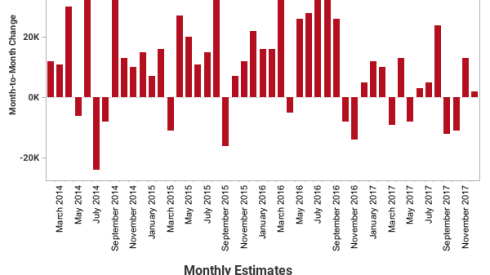
Total payroll employment rose by 321,000 in November, but public-sector job growth remained unchanged.

A roundup of money (and other) news governments can use.
A federal appeals court on Wednesday upheld a lower federal court ruling that Gov. Rick Scott's crusade to conduct drug tests on welfare recipients as a condition of their benefits was unconstitutional.
An estimated $270 million in federal funding was left on the table when Illinois lawmakers didn't vote Wednesday on a measure to create a state-run health insurance exchange.
A white former police chief in a tiny South Carolina town has been indicted on murder charges in the 2011 shooting of an unarmed black man. The indictment Wednesday came the same day a Staten Island grand jury declined to criminally charge a white New York City police officer in the killing of Eric Garner.
A caravan of misery lined the sidewalk along Story Road. Evicted homeless people stood beside a seemingly endless row of shopping carts filled with their meager possessions as they watched city workers descend into "the Jungle" Thursday and begin dismantling the infamous encampment.
The chants are angry, but simple: "I can't breathe!" "Hands up, don't shoot!" "Black lives matter!" They have echoed from the American heartland to the coasts in the wake of two recent grand jury decisions that cleared white policemen in the deaths of unarmed black men.
A white Phoenix police officer shot and killed an unarmed black suspect he believed was reaching for a gun on Tuesday night, adding to a series of fatal clashes between police and civilians that has led to unrest throughout the country.
Back in the 1980s and 1990s, there was some lively debate among journalists and political scientists about what voters were trying to say when they split their tickets and gave themselves divided
state government.
It was an important issue back then because most of the country was actually doing this—electing a governor from one party and a legislature from the opposing side, or voting for a Democratic majority in one legislative chamber and a Republican majority in the other. Both the 1988 and 1996 elections produced 31 states with divided government of one sort or the other.
Some states lived under this form of divided power for long periods of time. New York was the most conspicuous example. Its governorship was up for grabs every four years, but no matter who won it, voters could be counted on to bring in a Republican Senate and a Democratic Assembly, guaranteeing a split-the-difference government in which months of awkward backroom compromise ultimately gave both sides a little bit of what they wanted.
It was widely believed in those days that a large portion of the electorate was splitting tickets by design, giving each party a slice of control to prevent the other one from accumulating a monopoly on political power. I never thought this made much sense. I knew I didn’t vote this way, and I had never met anybody who did. As far as I could tell, most voters opted for individual candidates based on the limited supply of information they possessed about what the candidate would actually do in office. They didn’t march into the voting booth and deliberately select one from column A and one from column B, as if they were ordering food in an old-time Chinese restaurant.
The debate has largely subsided in recent years as divided government has gradually lost its prominence on the political scene. States have been moving into the all-red or all-blue category, voting for governments in which one party controls the governorship and both chambers of the legislature at the same time. During the past decade, divided government reached its modern low point. After the 2012 election, only 12 states fit in the divided category.
This past November, however, divided government made a comeback at the state level (see “The Republican Hour,” page 24). Nineteen states are now in split-power situations, including several large ones: Illinois, Maryland, Massachusetts, Minnesota, New York and Pennsylvania, to name just a few. So it makes sense to pose a question that hasn’t been asked too much lately: What consequences does divided government have for public policy and the politicians chosen to enact it?
If you ask John Hickenlooper, the just-barely-re-elected governor of Colorado, he’ll probably tell you that dividing power isn’t such a bad way to govern a state. Hickenlooper, a Democrat, won his first term in 2010 by portraying himself as a judicious centrist eager to work with both parties. That was prudent because Democrats were running the state Senate and Republicans controlled the House. In the resulting atmosphere of split power, state politics passed a peaceful two years, in which the two parties generally cooperated and Hickenlooper preserved his reputation for remaining somewhere above the battle.
In 2012, the situation abruptly changed. Democrats took over both chambers of the legislature, and the governor was forced into a posture of partisan leadership that didn’t really suit him. The House and Senate passed strict regulations on gun ownership and environmental protection, and Hickenlooper stuck with his party and signed them. The ensuing uproar unraveled the governor’s bipartisan image and set up a bitterly divisive campaign in which Hickenlooper won a second term by just a couple of percentage points. He had been a stronger leader, and the state’s politics had been vastly more civil, when power was divided. That might augur well for the next couple of years, because the 2014 election gave the state Senate to Republicans, ushering in a new period of divided party control.
But for every John Hickenlooper, there’s at least one Mark Dayton. Elected as a liberal Democrat in Minnesota the same year Hickenlooper won his first term in Colorado, Dayton found himself dealing with divided government of a much different sort. He and the Republican legislature immediately launched into a nasty game of brinksmanship over the budget, one that was resolved only after an embarrassing three-week shutdown of state government in the summer of 2011. Dayton vetoed 57 bills in his first two years in office. He became an effective governor only after November 2012, when his party swept to control in both chambers of the legislature. Democrats proceeded to enact a long list of liberal initiatives that included bills instituting gay marriage, raising the minimum wage and substantially increasing state spending on education.
Republicans pushed back against all these Democratic initiatives, but failed to mount a competitive campaign against Dayton’s re-election in 2014. They did, however, win back the Minnesota House, so Dayton in 2015 will confront a divided partisan alignment similar to the one Hickenlooper presided over at the start of his tenure. Whether the two parties in Minnesota can forge an effective split-power arrangement, or whether they return to the scorched-earth politics of four years ago, will be one of the intriguing questions of state politics in 2015.
This will be true in other places as well. It’s hard to imagine Democratic Gov. Tom Wolf getting much of what he wants from a staunchly Republican legislature in Pennsylvania or, conversely, Republican Bruce Rauner having an easy time dealing with the heavy Democratic majorities in Illinois.
It may have occurred to you that judging these various political situations is a highly subjective business. If so, you are right. It depends to a great extent on whether your party is winning or losing. Minnesota’s last two “peaceful” years weren’t very comfortable for the Republican legislative minority, which had to sit and watch quietly as Democrats pushed through a liberal agenda. Colorado’s Democrats didn’t enjoy the partisan bitterness that marked the past two years in that state, but many of them felt it was an acceptable price to pay for the passage of environmental bills they had been waiting years to enact. What was good for Hickenlooper, in other words, wasn’t necessarily good for all the major players in
state politics.
I think it’s fair to say, in fact, that prolonged periods of divided government, especially when they generate intense partisan anger and personal hostility, tend to be corrosive to the political process as a whole. I would apply that standard to the strife that has marked politics in Maine since the beginning of 2011.
That year marked the accession to power of Paul LePage, the bombastic and quarrelsome Republican governor elected with a minority of the vote in a three-way contest the previous fall. LePage began insulting Democrats almost from the day he was sworn in. And Democrats were not shy about insulting him back. The result was an era of bad feelings that had not been seen in Maine for generations. Le-Page actually managed to win passage of a fair number of his priorities, most notably tax cuts, because he came in with Republican majorities in both chambers of the legislature. But it was not a pleasant time to be a legislator in either party, or even a politically active citizen watching the show from the audience.
It was tempting to believe that Maine politics couldn’t get any more acrimonious, but in 2012 it did. Democrats took back the legislature. LePage refused even to speak to them and for a time declined to offer them a budget to vote on. The Democratic majority sent the governor a steady supply of legislation, waited for his veto and then debated whether or not to override him. This year is almost certain to provide a fresh round of bickering, since LePage won re-election (again with a minority of the vote) and each party controls one of the two chambers.
You can say that Maine’s system of government has survived the LePage years. But it has survived at the cost of persuading a large core of voters that the state’s politics is a circus of name-calling and petty rivalry that few sensible citizens would want to participate in. And while Maine may be an extreme case, I fear that some of the states that voted for divided government in 2014 are going to see some of the same unpleasantness in the next couple of years.
It wasn’t always this way. A generation ago, when the ideological divide between the two parties was less pronounced, and politics in most legislatures proceeded largely on the basis of personal relationships, divided government tended to work rather well, or at least more smoothly. When Nelson Rockefeller was governor of New York, from 1958 to 1973, he cut deals with legislative Democrats that produced a flood of innovative programs in education, housing, environmental protection and a wide variety of other policy areas. Not all the programs ended up succeeding as planned, but both parties went home each year with most members believing that something significant had been accomplished.
Similarly, in the 1990s, Republican William Weld governed heavily Democratic Massachusetts with a style that featured occasional partisan bluster but also personal comity with the majority party’s leaders. Once, when asked how he managed to get along with Democratic Senate President William Bulger, Weld replied, “It’s simple. He makes funny jokes, and I laugh at them.”
Perhaps something like that will happen somewhere this year, but I’m inclined to doubt it. In many of the states living under divided government, it is likely to be a trying year. g
Email aehrenhalt@governing.com
Cleveland police have routinely engaged in "unreasonable and unnecessary" force, including a half-hour police chase involving 100 officers that left two unarmed African-Americans dead when police mistook the car backfiring for gunshots and shot each of them more than 20 times, a Justice Department investigation revealed Thursday.
The plan, called A Healthy Florida Works, offers an alternative to the ACA model while proposing a politically viable path for Florida’s Republican-controlled House of Representatives to extend coverage to more residents.
The Florida capitol’s holiday display will include a festive message from the Satanic Temple.
Under the new procedure, reporters will be required to affirm that they do not lobby or advocate for a political party, group or individual.
Los Angeles City Atty. Mike Feuer asks a judge to stop a smartphone app that allows people to order pot and alcohol delivered to their doors.
Affordable technology is providing new ways for governments with limited resources to improve their services and engage with residents.
Maggie Miller, former CIO of the Girl Scouts of the USA, will make New York state her eighth CIO position.
States don't when or whether funding for the federal-state, low-income Children’s Health Insurance Program will be authorized beyond Sept. 30, when it is set to expire.
Former Health and Human Services Secretary Kathleen Sebelius, on the disastrous debut of the federal health insurance website.
Most Read









