

In Brief:
- Public transportation plays a starring role in the Dallas area’s World Cup transit planning, given that many attendees are traveling to the area from overseas and won’t have a car.
- The Dallas region’s transit plans include a special shuttle bus service, traffic signal control, crowd management, translation services and more.
- The North Central Texas Council of Governments is pulling lessons from past events and preparing to respond fast to unexpected hiccups.
Dallas and the surrounding area are expecting over 1 million World Cup visitors over the course of a month of games this year, from mid-June to mid-July. Managing an influx of that size is logistically tough for cities, particularly when it comes to transportation. Planners need to make sure they can get fans safely and quickly to the Arlington, Texas-based stadium in time for each of the nine games, regardless of bad weather or other mishaps that might crop up.
During those earlier events, a temporary shuttle bus service took fans from the local commuter rail station directly to the stadium. Officials are returning to that idea for the World Cup.
“In the Super Bowl, when we offered [the shuttle], we had maybe about 2,000 riders that took that. For this, we’re expecting about 10,000,” says Natalie Bettger, senior program manager at North Central Texas Council of Governments, which is taking the lead on transportation planning for the area’s World Cup matches.

©James D. Smith/North Texas FWC/©James D. Smith/North Texas FWC
Preparations have also required some physical infrastructure projects. Unlike past events, where the shuttle could just drop attendees off outside the stadium, officials have a designated parking lot for World Cup fans. They are also preparing to have police manage and direct the crowds in areas around the stadium. The parking lot got a revamp, including repaving, an additional entrance to allow for faster services and an expansion of the existing entrances so shuttle buses can turn more easily. Officials are also making sure the parking lot has restrooms, shade from the summer sun, water and other amenities for fans waiting for the next shuttle bus.
For smooth transportation, the city of Arlington is blocking off the road next to the stadium to all traffic except the shuttle buses. The city also upgraded its traffic signal system to be able to grant shuttle buses more green lights or hold four-way red lights for pedestrian movements.
The train station where the shuttle will collect fans also got new cameras, for both security and operational purposes. The video feed will help operations teams monitor how many people are waiting for a shuttle or train and see if they need to intervene to speed things up.
Preparing for the Unexpected
Taking a lesson from past events, officials will conduct road sweeps on match days to clear any debris or abandoned vehicles. They’ll also station tow trucks along the route to be ready to respond quickly should there be a crash.
“We want to make sure folks are in their seats before the match starts. That’s our most critical goal of the whole plan,” Bettger says. “We’ve tried to build in a lot of resiliency, just because things can happen that we don’t really have control over.”
Officials have prepared a backup “bus brigade” that could take over if the commuter rail service that transports people to the shuttle cannot run for some reason or hits maximum capacity. The buses would provide transport between different rail stations and the stadium’s shuttle bus lot. They’re considering how to handle a sudden turn in the weather, like a surprise thunderstorm disrupting the summer heat just as fans are exiting the stadium (in such a case, officials would likely load them into shuttle buses to shelter until the skies clear).
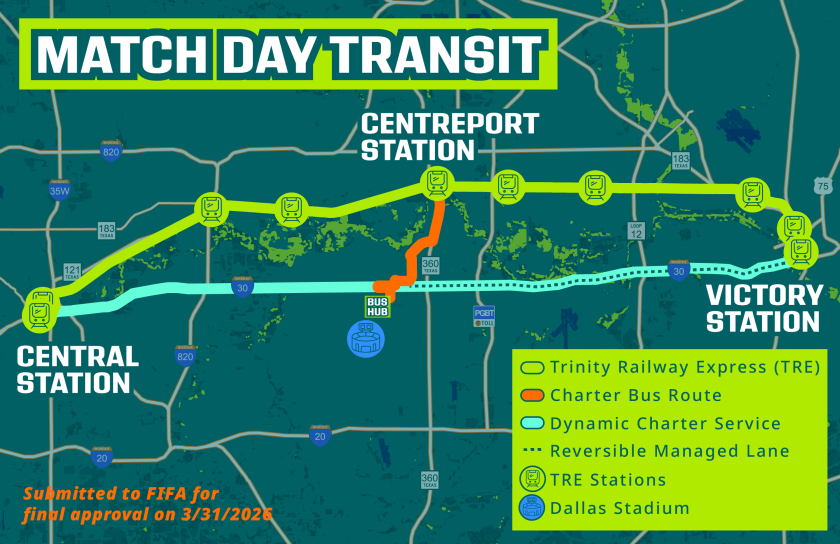
Credit: North Central Texas Council of Governments
Looking Ahead
One month out from the first match, officials are fine-tuning transit plans and tackling last minute questions. (Among the latest: where to designate a drop-off spot for the private hotel shuttles, so these vehicles don’t just pause in the road, holding up traffic.)
While hosting the World Cup is a bigger ordeal than many events, it also brings one benefit for planners: plenty of data.
Cities’ host committees are sharing one-page “transportation fact sheets” with each other after each match about what they experienced from each team’s fans. For example, what portion of a particular team’s fans drove versus took public transit, and whether the fans followed pedestrian rules or jumped barriers and ran across the streets.
And while most big events are one-off experiences, the Dallas area is hosting many matches — each one a new chance to analyze what worked and what could be improved for next time, Bettger says: “Usually we do it one time, and we get one chance, and we learn from it, but here we have nine times within five weeks, which is really cool, because you usually don’t get that opportunity.”









