That's problematic. Without a serious evaluation of program effectiveness, politics tend to dictate important budget decisions, and arguments over stakeholder interests and political palatability drown out important questions of real-world impact.
As a result, states and cities respond to record budget shortfalls with across-the-board cuts, and some vital public services end up on the chopping block unnecessarily.
That's why we've developed the "Reviewing What Works" tools, a process for evaluating the effectiveness of government programs. They are part of a Center for American Progress report entitled The Secret to Programs that Work.
The key to the Reviewing What Works approach is an interagency assessment of effectiveness with specific, concrete steps to compare various programs. The tools include a series of basic questions that should be asked of every existing program: What impact has it had on the problem it's trying to solve? How does it compare to other programs with similar goals? Is it well run?
Given the grim budget picture, statehouses need to focus on cost effectiveness.
"Openly measuring the performance of our public institutions, and communicating that performance to citizens, has never been more important," Maryland Gov. Martin O'Malley said at Governing magazine's annual Outlook in the States and Localities conference. "The states that win will be the states that...manage for results."
So how would a rigorous managing-for-results strategy actually work?
With input from dozens of federal and state government officials and outside performance experts, we compiled a set of key performance indicators for government programs. This informed a set of six basic questions that should be asked for every existing program:
- What goals across government is the program contributing to?
- What impact does the program have on achieving those goals?
- Does the program work well with other programs to maximize impact and minimize duplication?
- How cost effective is the program compared to others?
- Is the program well run? Have there been delays or cost overruns?
- Does the program learn from experience and improve in response?
The tools are built to facilitate a fair, comprehensive assessment of the results of programs that seek common goals. To overcome the tendency of government programs to operate in semi-independent silos, we took an interagency approach to these evaluations.
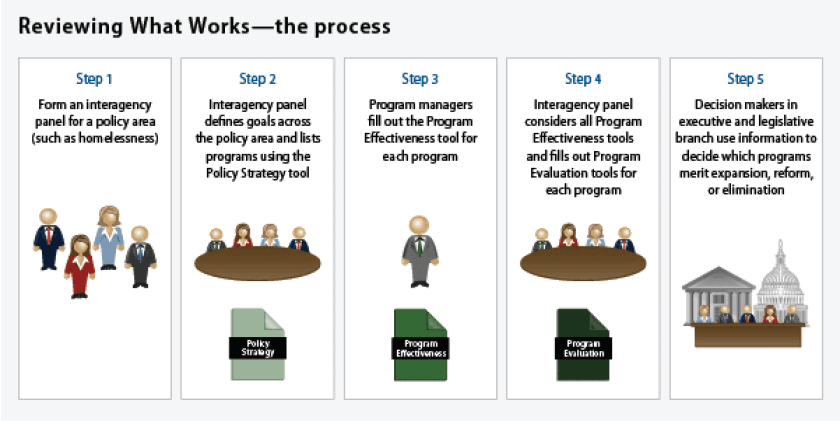
So the first step in the Reviewing What Works success process is the creation of interagency panels around particular program areas like economic development, homelessness, transportation or workforce training. These panels would include heads of relevant agencies, program managers, budget staff, notable academics and other outside experts.
Each interagency panel's first task is to agree on common outcome goals in that program area. So for homelessness, the panel may agree to cut chronic homelessness in half over five years, or eliminate veteran homelessness over ten years. The panel then compiles a list of all current programs that are working toward achieving these goals. With that inventory complete, the evaluation stage begins.
Here's how it would work. For each program on the list, program managers fill out a questionnaire with the basic performance information listed above. The interagency panel then verifies that information and uses a second tool to assess each program's effectiveness relative to other programs with similar goals. All this information is passed along to decision makers to guide their scrutiny during the budget debate.
To be sure, the Reviewing What Works evaluation will never replace consideration of the political implications of each budget cut. But the information in these tools will provide a counterbalance to interest group pleading, ensuring that critical questions of program performance make their way into the debate.
Reaching that point certainly won't be easy. Many bureaucracies may find it unnatural to take an interagency approach to assessing the effectiveness of programs. It may be difficult for the panels to agree on common goals and performance standards with real-world budget implications. And it will take time to convince program managers to honestly report their program's shortcomings.
But difficult times often require difficult changes. We simply can't afford to accept the business-as-usual approach. It's time for serious fiscal conversations, framed around equally serious measurement of results.