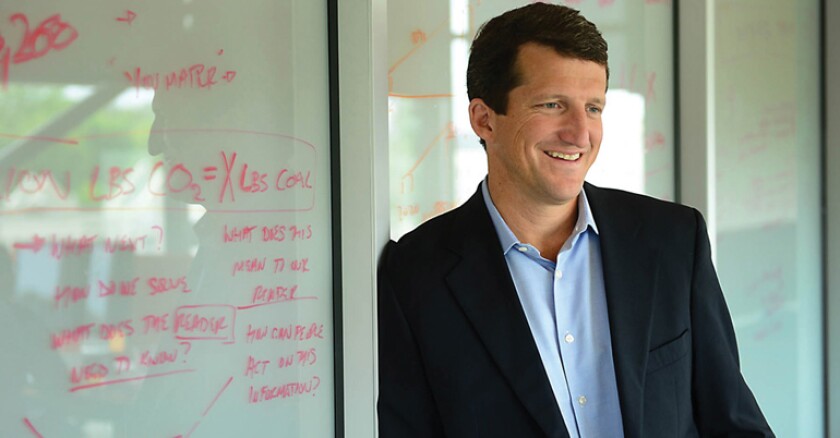
Last year, hedge fund billionaire Tom Steyer spent about $75 million seeking to influence state and federal elections in favor of candidates worried about climate change. He’s still spending freely, but now he might be topped by another rich guy, Jay Faison, who says he’ll pony up $175 million toward the cause. In some ways, Faison’s task is harder: He’s devoting his efforts toward convincing his fellow Republicans to take the issue seriously.
Faison, a conservative Christian and a business entrepreneur in Charlotte, N.C., says he wants to use his money to help shift the conversation among Republicans when it comes to climate change. “We want to move people away from the, ‘Are we causing it?’ and into the, ‘How are we going to solve it?’” he told The Washington Post earlier this year.
It’s hard to remember now, but a decade ago concern about climate change was shared on a bipartisan basis. Over time, it’s become fairly rare to find GOP politicians embracing the issue. Ohio Gov. John Kasich has expressed concern over the years, but as part of his presidential run he’s felt compelled to sound more skeptical, worrying about job loss and referring to climate change as “some theory that’s not proven.”
Part of what has driven Republican doubts, environmentalists say, is the big money donations coming their way from the energy sector. Serious dollars from Faison offer a potential counterweight. “It’s a very positive development to have a Republican philanthropist who wants to support climate action candidates,” says Daniel Weiss of the League of Conservation Voters.
These days, however, even $175 million only makes so big a splash in the political pond. In the super PAC era, big donors are certainly welcomed, but they don’t necessarily stand out among the crowd. “At this point in time in politics, there are multiple billionaires on the block,” says Dave Levinthal of the Center for Public Integrity, a watchdog group. “There are dozens of people who will inject a million or multiple millions into campaigns.”

Hedge fund billionaire Tom Steyer spent about $75 million last year supporting candidates worried about climate change. (Anne Cusack/Los Angeles Times/MCT)
For all his money, Steyer’s impact was limited last year. His win-loss ratio was quite poor. And even if more money is flowing toward candidates, voter interest in climate change has remained remarkably ho-hum. In poll after poll, it has failed to register as a top priority, even among those convinced it’s real and a major threat.
Still, a huge influx of cash can certainly attract added attention -- not just from politicians, but from reporters. “Real change comes from the grassroots, but the support of some big donors certainly helps,” says Jamie Henn, spokesman for the environmental group 350.org. “You’d think that when 97 percent of scientists and a majority of the public are clamoring for action, that would be enough to drive change, but sadly most politicians respond to money above all else.”